Why must students stay with their chaperone at all times?
Analyze and Evaluate Information and Ideas · TELPAS Grades 4–5 reading. The correct answer, and the reasoning behind it.
Reporting category 3: make inferences, draw conclusions, and think about why the author wrote a text and how it is built.
Read the schedule. Then answer the questions.
Field Trip Schedule
Read image description
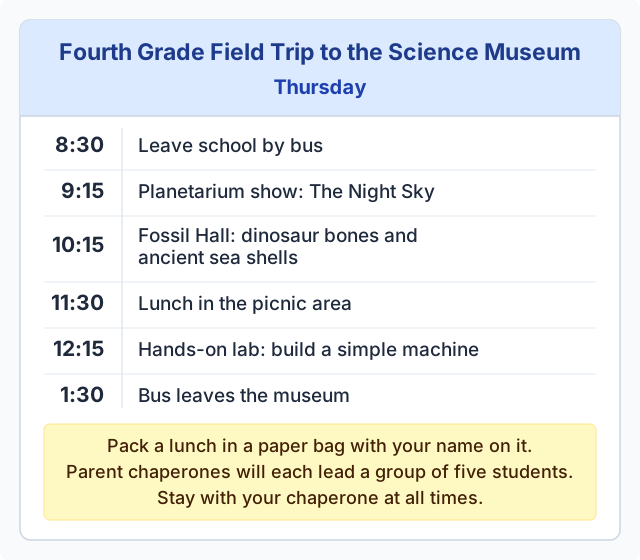
Fourth Grade Field Trip to the Science Museum — Thursday
8:30 Leave school by bus
9:15 Planetarium show: The Night Sky
10:15 Fossil Hall: dinosaur bones and ancient sea shells
11:30 Lunch in the picnic area
12:15 Hands-on lab: build a simple machine
1:30 Bus leaves the museum
Pack a lunch in a paper bag with your name on it. Parent chaperones will each lead a group of five students. Stay with your chaperone at all times.
The question
Choose the best answer.
Why must students stay with their chaperone at all times?
- so the chaperones can carry everyone's lunch
- so students can sit together on the bus
- so that no student gets lost in the museumCorrect answer
- so the museum can count how many tickets it sells
Why “so that no student gets lost in the museum” is correct
The schedule gives the rule but not the reason, so the student has to infer it. A chaperone leads a small group of five, and staying together in a large, busy museum keeps everyone safe and accounted for. This is a common kind of question about why a rule exists.
Why the other answers are wrong
- so the chaperones can carry everyone's lunch — Each student packs and brings their own lunch.
- so students can sit together on the bus — The rule is about the whole visit, not the bus seats.
- so the museum can count how many tickets it sells — Tickets are never mentioned.
Practice more of this
More reading practice for Grades 4–5, or see the TELPAS practice test for 4th and 5th grade.
This is an independent study resource. It is not affiliated with, endorsed by, or connected to the Texas Education Agency or the official TELPAS program. All questions here are original practice material written to match the published test design.